

About Curriculum


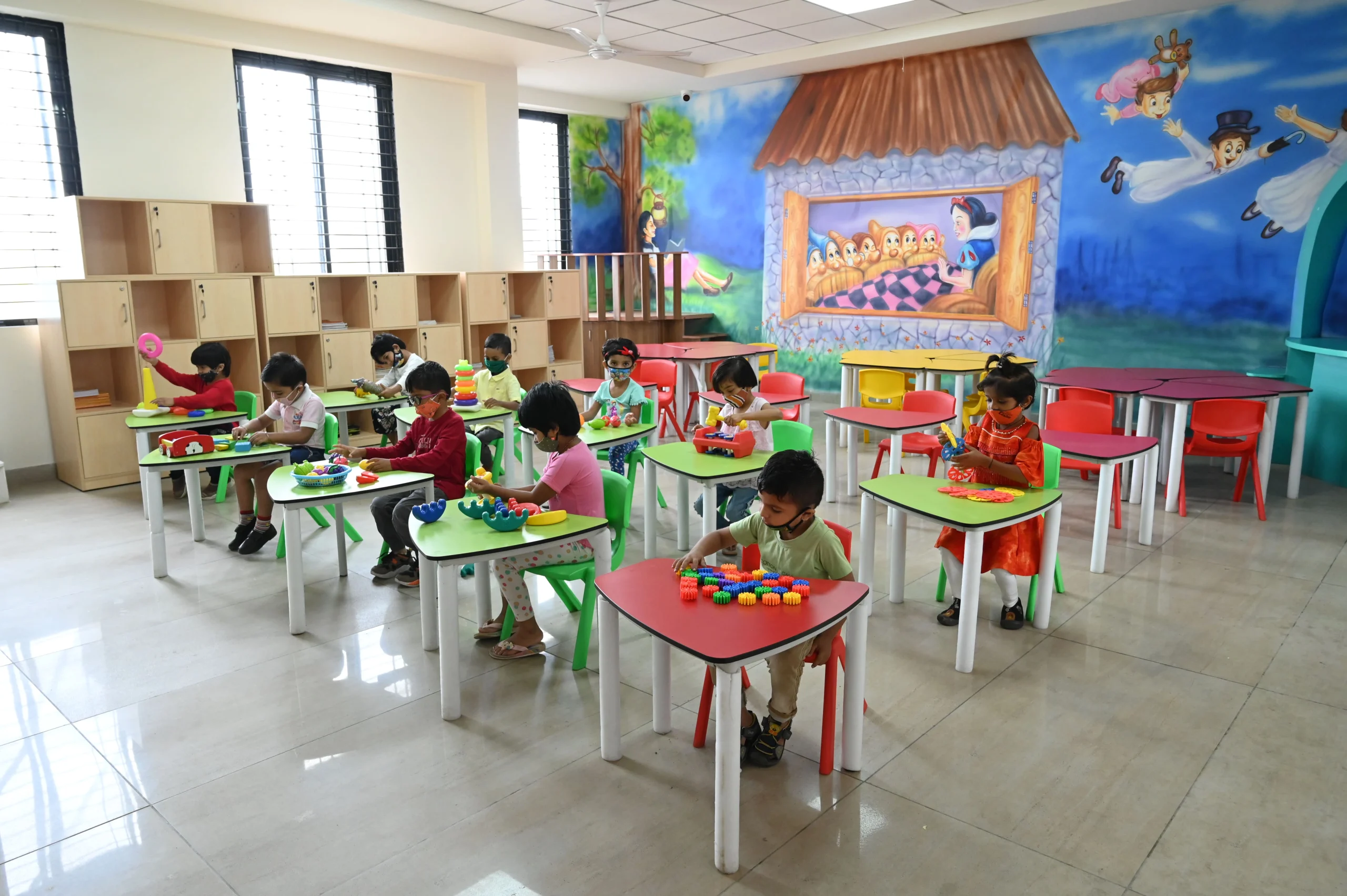
Early Childhood Program Research in the field of Early Childhood Education underscores that the critical development of a child’s brain occurs primarily during the initial five years of life. As a result, our pre-primary curriculum is meticulously crafted to introduce and engage the child across various cognitive domains.
Our thoughtfully structured competency and skill-centered program offer a diverse array of experiences and resources aimed at nurturing and augmenting physical, motor, social, emotional, aesthetic, and intellectual growth. With our small class sizes, we ensure ample time and opportunities for individual interaction with educators, facilitating personalized attention and tailored learning experiences.
The curriculum places a strong emphasis on cultivating a multitude of skills, which is accomplished through age-appropriate monthly thematic units (projects).
Projects
- Physical Development: This encompasses both fine motor and gross motor development.
- Creative/Aesthetic Development: This includes Visual Arts and Performing Arts (Music, Drama, and Role Play).
- Cognitive And Perceptual Development: The focus here is on the development of Language, Literacy Skills, and Numeracy Skills.
- Social And Emotional Development: This is achieved through group play, sharing, and interpersonal communication.
Teaching Approach: Within a nurturing, secure, and joyful school environment, we provide a wide spectrum of enriching experiences, including drama, storytelling, creative and cognitive activities, science experiments, fireless cooking, water-based activities, and field trips. These experiences contribute significantly to a well-rounded and meaningful developmental journey for our young learners.
Career Development, Design Thinking, Project Based Learning, Seminar, Novel Reading, School Cinema, Newspaper Reading, Science Expo, Maths Expo, Life Skills.
Primary Education Program with NEP-Based Curriculum
Within our Primary Section, our primary objective is to establish a robust foundation for future learning in every child, aligning with the principles of the National Education Policy (NEP). We blend the traditional 3Rs (Reading, Writing, and Arithmetic) skills with the essential 4Cs skills demanded by the 21st century, as emphasised by the NEP:

- Critical Thinking and Problem Solving
- Communication
- Creativity
- Collaboration
Secondary Education Program with NEP Alignment
Our secondary program at Sanjivani International School aligns seamlessly with the National Education Policy (NEP) while following the CBSE curriculum, which is based on the National Curriculum Framework defined by NCERT. This NEP-aligned program encompasses the following key features:
Life Skills Development
Recognizing the importance of life skills, we prioritise their development among our students. Our aim is to equip them with the essential skills necessary to navigate the challenges of the world with confidence.
Student Mentorship
To prepare students for success in examinations and foster personality development, we conduct mentorship sessions. These sessions impart essential skills and qualities required for not only academic achievement but also personal growth.
Continuous and Comprehensive Evaluation (CCE)
We adhere to the CCE framework, as recommended by the NEP. This approach ensures that learning is an ongoing and dynamic process. It places emphasis on the development of multiple intelligences through diverse methods, including the use of Visual Aids (ICT-enabled classrooms), computer-aided learning, and practical hands-on experiences.
Focus on Fundamental Learning
Our approach places a strong emphasis on reinforcing the foundational concepts acquired in the previous academic year. Additionally, we target the identification and improvement of specific developmental areas throughout the term, ensuring a solid academic grounding.
Career Guidance
In alignment with the NEP's vision, our secondary program is designed to empower each student to make informed career choices. The school conducts career counseling workshops and utilizes scientific assessments to help students identify their aptitudes and interests, enabling them to make well-informed career decisions.
Holistic Education Beyond Academics
Sanjivani International School goes beyond academic excellence to provide a balanced education that encompasses a wide range of co-curricular and extra-curricular activities, reflecting the NEP's holistic approach:
Co-curricular Activities (CCA)
Our CCA program includes various project activities, including Art & Craft and Culinary Arts
Sports Program
We prioritise physical literacy through the scientific development of fundamental movement skills
Visual and Performing Arts (VPA)
Students are exposed to the world of Music, Dance, and Drama, fostering their creative and expressive abilities.
Workshops and Field Trips
Regular workshops and educational field trips are conducted to enhance the teaching and learning process, aligning with the NEP's emphasis on experiential learning
New Offerings
We have recently introduced Mini-MBA, Robotics, Coding, and Fashion Designing programs, further enriching the overall development of our students and keeping pace with the evolving educational landscape outlined in the NEP.